


Views: 18
Starting a business in India is exciting, but the first big question is always the same: which structure should you choose? For most founders, startups and growing businesses, the answer is a private limited company. In this guide, we explain how to register a private limited company in India in 2026, covering every step, document, fee and compliance in simple language.
Private limited company registration gives your business a separate legal identity, limited liability protection for its owners, easier access to funding and a strong brand image. At Trisuka, our professional fee for private limited company registration is just ₹7,999 (government fees and stamp duty extra, as applicable), and our team handles everything from name approval to the Certificate of Incorporation. If you want expert help right now, you can contact the Trisuka team for a free consultation.
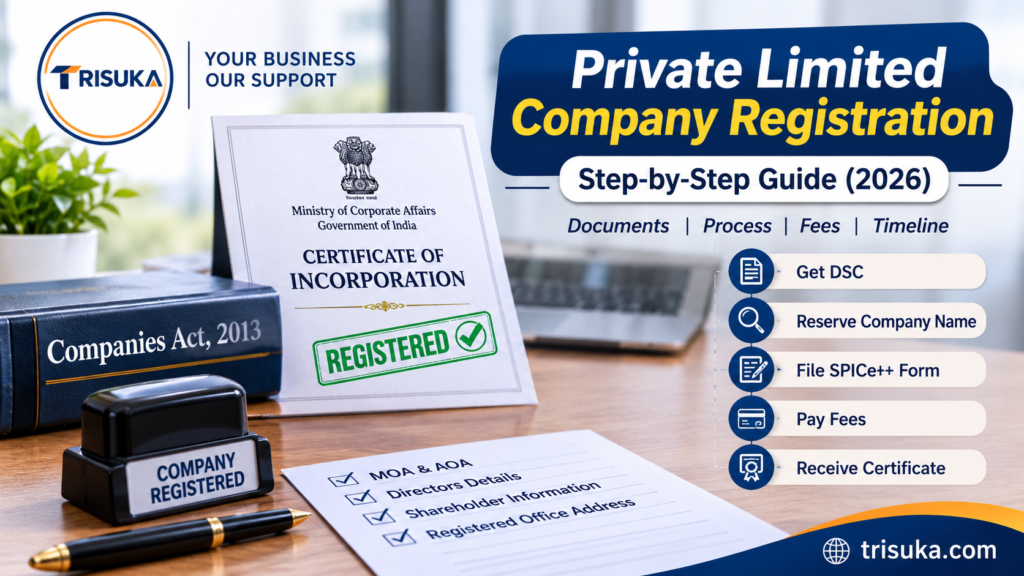
Delays usually happen because of name objections, incorrect address proof or mismatched details across documents. Proper preparation is the fastest way to complete private limited company registration smoothly.
What Is a Private Limited Company?
A private limited company is a business structure governed by the Companies Act, 2013 and regulated by the Ministry of Corporate Affairs (MCA). It is called “private” because its shares cannot be offered to the general public, and “limited” because the liability of shareholders is restricted to the unpaid value of the shares they hold. In simple words, if your company runs into debt or legal trouble, your personal assets such as your house, car or savings are generally not at risk. That single feature is the main reason entrepreneurs prefer private limited company registration over a sole proprietorship or a partnership firm.
The company is a separate legal entity, distinct from its owners. It enjoys perpetual succession, which means it continues to exist even if a director or shareholder leaves or passes away. It can own property, sign contracts, and sue or be sued in its own name. Ownership is divided into shares, which makes it easy to bring in investors as your business grows.
Why Choose Private Limited Company Registration for Your Business?
Before we get into how to register a private limited company, it helps to understand why so many founders prefer this structure over others.
Limited Liability Protection
Your personal assets stay separate from business liabilities. This is the biggest advantage of private limited company registration and the biggest difference from a proprietorship, where the owner is personally responsible for every debt of the business.
Better Credibility and Trust
Banks, vendors, clients and government departments take a private limited company far more seriously. Many large corporates and tenders prefer to work only with registered companies, so having “Private Limited” after your brand name opens doors that stay closed to unregistered businesses.
Easy Fundraising
Angel investors, venture capital funds and banks usually invest only in companies. If you plan to raise equity funding at any stage, private limited company registration is almost a must, because shares can be issued, valued and transferred in a clean and legally recognised way.
Startup India Benefits
A company incorporated as a private limited company can apply for DPIIT recognition under the Startup India initiative. Recognised startups can enjoy benefits such as tax exemptions, easier compliance and self-certification under certain labour and environment laws.
Transferability of Shares and No Minimum Capital
Shares can be transferred, which makes the entry and exit of partners smooth without closing the business. On top of that, there is no minimum paid-up capital requirement for private limited company registration, so you can begin with a modest authorised capital and increase it later as your business scales.
Eligibility and Basic Requirements for Private Limited Company Registration
Before you start, make sure you meet the basic requirements. A private limited company needs at least two directors and two shareholders, and the same person can be both a director and a shareholder. The maximum number of members is 200. At least one director must be a resident of India, meaning a person who has stayed in India for at least 182 days in the previous calendar year. Every director must be at least 18 years old and must hold a valid PAN if they are an Indian national, or a passport if they are a foreign national.
Your company also needs a registered office address in India. It can be rented, owned or even a shared space, as long as you have valid proof of address and a no-objection certificate from the owner. Finally, the proposed company name must be unique and must not match or closely resemble an existing company or trademark. We cover the naming rules in detail later in this guide.
Documents Required for Private Limited Company Registration
Keeping your paperwork ready saves days, so let us look at the standard document checklist for private limited company registration.
For Directors and Shareholders (Indian Nationals)
Every Indian director and shareholder must provide a PAN card, which is mandatory, along with an identity proof such as an Aadhaar card, voter ID, passport or driving licence. You will also need an address proof such as a bank statement, mobile bill or electricity bill that is not older than two months, a recent passport-size photograph, and a valid email ID and mobile number.
For Foreign Directors or Shareholders
Foreign nationals must submit their passport and an address proof from their home country, both notarised or apostilled as applicable. If the person is currently in India, a copy of the visa is also required.
For the Registered Office
For the registered office, you need a rent agreement or sale deed, a no-objection certificate from the property owner, and a latest utility bill such as electricity, water or gas that is not older than two months. If you are unsure whether your document set is complete, our business registration services team will check everything before filing.
How to Register a Private Limited Company: Step-by-Step Process
Now let us look at the actual process. The entire private limited company registration is done online through the MCA portal using an integrated web form called SPICe+ (INC-32). Here is how it works from start to finish.
Step 1: Obtain Digital Signature Certificate (DSC)
All proposed directors need a Class 3 Digital Signature Certificate, because the incorporation forms are signed digitally. The DSC is issued by government-authorised certifying agencies after identity verification and usually takes one to two days.
Step 2: Get Director Identification Number (DIN)
A DIN is a unique number assigned to every director. The good news is that for a new company, you can apply for the DIN for up to three directors within the SPICe+ form itself, so no separate application is needed.
Step 3: Name Reservation (SPICe+ Part A)
Choose a name and submit it in Part A of the SPICe+ form. You can propose up to two names in order of preference, and the MCA either approves or rejects them, usually within a few days. The name must end with “Private Limited” or “Pvt. Ltd.”, must not be identical or too similar to an existing company or registered trademark, and should not use restricted words such as “Bank”, “Government” or “National” without prior approval. It should also reflect your business activity or be a distinctive brand name. Before filing, we recommend a trademark search on the IP India website so that you do not face an objection later.
Step 4: File SPICe+ Part B (Incorporation Details)
Once the name is approved, you complete Part B of the form. This includes company details such as the registered office, authorised capital, subscribed capital and main objects, as well as details of directors and subscribers. You can also apply for PAN, TAN, EPFO, ESIC, GST (optional), professional tax (state-specific) and bank account opening through linked applications. This integration is the best part of the modern private limited company registration process, because several registrations happen together in one filing.
Step 5: Prepare MOA, AOA and Other Forms
Along with SPICe+, you file the electronic Memorandum of Association (INC-33), which defines the company’s objectives and scope, and the electronic Articles of Association (INC-34), which define internal rules and management. A linked application called AGILE-PRO-S (INC-35) covers GSTIN, EPFO, ESIC and bank account details. All documents are digitally signed by the directors and by the professional (CA, CS or CMA) who certifies the filing.
Step 6: Pay the Government Fees and Stamp Duty
Fees depend on your authorised capital and your state’s stamp duty rules. For companies with authorised capital up to ₹15 lakh, the MCA registration fee is generally nil under the current SPICe+ framework, while stamp duty on the MOA and AOA varies from state to state. We explain the cost breakup in the next section.
Step 7: Receive Certificate of Incorporation
After the Registrar of Companies (ROC) verifies the documents, you receive the Certificate of Incorporation (COI) along with your company’s Corporate Identification Number (CIN), PAN and TAN. The entire private limited company registration usually takes around 7 to 15 working days, depending on name approval and document accuracy. You can verify all official forms and notifications anytime on the Ministry of Corporate Affairs website.
Private Limited Company Registration Fees in India (2026)
Cost is one of the most searched topics around private limited company registration, so let us be completely transparent about it.
Trisuka Professional Fee: ₹7,999
Our professional fee for private limited company registration is ₹7,999. This covers consultation, documentation, name search and approval support, DIN and DSC guidance, MOA and AOA drafting, and filing of SPICe+ with the ROC. Government fees and stamp duty are charged separately, at actuals.
Government Fees and Other Costs
A Digital Signature Certificate typically costs around ₹1,000 to ₹2,000 per director. The name reservation fee is as per MCA norms. The MCA incorporation fee is nil for authorised capital up to ₹15 lakh and slab-based above that, while stamp duty on the MOA and AOA varies by state. PAN and TAN are included in the SPICe+ application at no separate cost. Please note that these figures are indicative, and the MCA and state governments revise fees from time to time. Always check the latest rates on the official MCA portal, or speak to our team for an exact quote for your state and capital.
Ongoing Costs After Registration
After private limited company registration, remember the yearly costs of a statutory audit, ROC annual filings, income tax return and GST returns if applicable. Budget for these from day one so that you are never caught off guard.
How Long Does Private Limited Company Registration Take?
A typical timeline starts with one to two days for the DSC, followed by two to four working days for name approval. SPICe+ filing and ROC approval then take another three to seven working days, which brings the total to about 7 to 15 working days. Delays usually happen because of name objections, incorrect address proof or mismatched details across documents. Proper preparation is the fastest way to complete private limited company registration smoothly.
Private Limited Company vs LLP vs Sole Proprietorship
Many founders wonder if this structure is really the right one for them, so here is a quick comparison.
A private limited company is best for startups, scalable businesses and founders who want funding. It has the highest credibility and limited liability, though it comes with more compliance than other forms. A Limited Liability Partnership (LLP) is good for professional firms and small businesses, offering limited liability with lower compliance, but raising venture funding is harder. A sole proprietorship is the easiest and cheapest to start, but it has no separate legal identity and the owner carries unlimited personal liability. If you plan to grow, hire a team, take investment or build a brand, private limited company registration is almost always the smartest long-term choice.
Compliance After Private Limited Company Registration
Getting your certificate is only the beginning. A company must follow ongoing legal requirements to stay active and avoid penalties.
Bank Account, Auditor and Share Certificates
Start by opening a current bank account in the company’s name using your COI, PAN and MOA/AOA, so that every business transaction goes through it. The first statutory auditor must be appointed within 30 days of incorporation by filing Form ADT-1, and share certificates must be issued to shareholders within the prescribed period.
Declaration of Commencement of Business (INC-20A)
Every company must file INC-20A within 180 days of incorporation and bring in the subscription money from the subscribers. Missing this deadline can lead to penalties and even strike-off.
Board Meetings and Annual Filings
A company must hold at least four board meetings every year, with a gap of not more than 120 days between two meetings, and the first one should be held within 30 days of incorporation. Every private company must also file AOC-4 (financial statements) and MGT-7 or MGT-7A (annual return) with the ROC every year, along with holding the Annual General Meeting.
Income Tax Return and GST
File the company’s income tax return each year on the Income Tax portal. If your turnover crosses the threshold or you supply across state lines, GST registration and periodic returns apply through the GST portal. Missing deadlines leads to heavy late fees, so many founders choose a professional partner for annual compliance as well.
Common Mistakes to Avoid During Private Limited Company Registration
Learning from others’ mistakes will save you time and money. The most common error is choosing a name without research, because names similar to existing brands get rejected or, worse, challenged later. A proper MCA and trademark search before filing prevents this. Another frequent problem is incorrect address proof, since old utility bills or missing NOCs are among the top reasons for ROC objections.
Founders also often fail to plan shareholding properly. Decide the shareholding pattern early, particularly if there are co-founders or investors, because changes later add cost and paperwork. Be careful with the main objects in the MOA as well. If they are too narrow, you may need to amend the MOA when you add a new service, and if they are too vague, the ROC may reject them. Finally, many new companies ignore post-incorporation compliance such as INC-20A, auditor appointment and annual filings, and late fees pile up quickly.
Why Choose Trisuka for Private Limited Company Registration?
When you choose Trisuka, you get more than a filing service. You get a team that understands founders. Our pricing is transparent, with a professional fee of ₹7,999 and no hidden charges. Every filing is reviewed by experienced professionals, and we support you end to end, from DSC and DIN to name approval, MOA/AOA and the Certificate of Incorporation. We give priority handling so that your business can start sooner, and we continue to help after registration with GST, MSME registration, trademark, bookkeeping and annual compliance, all under one roof. Visit Trisuka or book a free call and our experts will guide you through private limited company registration from start to finish.
Frequently Asked Questions (FAQs)
1. What is the first step in private limited company registration?
The first step is to get a Digital Signature Certificate (DSC) for all proposed directors. After that, you apply for name approval and file the SPICe+ form on the MCA portal.
2. How much does private limited company registration cost in 2026?
At Trisuka, our professional fee is ₹7,999. Government fees, DSC and state-wise stamp duty are extra and depend on your authorised capital and state. We share a clear breakup before we begin.
3. How many directors are required to register a private limited company?
A minimum of two directors is required, and at least one of them must be an Indian resident. The maximum number of directors is 15, which can be increased by passing a special resolution.
4. Can one person register a private limited company?
A normal private limited company needs at least two members. If you are a single founder, you can register a One Person Company (OPC) instead, or add a second shareholder and director.
5. What is the minimum capital required for private limited company registration?
There is no minimum paid-up capital requirement. You can begin with a small amount and increase the authorised capital later as the business grows.
6. How long does the private limited company registration process take?
It usually takes 7 to 15 working days, provided your documents are correct and the proposed name is approved without objection.
7. Can I use my home address as the registered office?
Yes, you can use a residential address as the registered office, as long as you provide a valid utility bill and a no-objection certificate from the owner.
8. Can an NRI or foreign national register a private limited company in India?
Yes. Foreign nationals and NRIs can be directors and shareholders, subject to FEMA and foreign direct investment rules. At least one director must be a resident in India.
9. Is GST registration compulsory after private limited company registration?
GST is mandatory only if your turnover crosses the prescribed threshold, or if you are involved in interstate supply, e-commerce or other categories where registration is compulsory. Many companies take voluntary registration for credibility and input tax credit.
10. What happens if I do not file annual returns?
Late filing attracts daily penalties, and continued default can lead to disqualification of directors and striking off of the company by the ROC. That is why timely compliance is essential after private limited company registration.
Conclusion
Now you know exactly how to register a private limited company in India: get your DSC, reserve a name, file SPICe+, submit the MOA and AOA, pay the fees and receive your Certificate of Incorporation. The process is online and fast, but small mistakes can cause long delays, and that is where a trusted partner makes all the difference.
Ready to Start Your Private Limited Company Registration?
Don’t let paperwork slow down your business idea. Get your private limited company registered with Trisuka at a professional fee of just ₹7,999, with expert guidance, transparent pricing and end-to-end support until your Certificate of Incorporation is in your hands.
👉 Get Started Today at Trisuka.com and book your free consultation now. Our team is ready to take care of everything while you focus on growing your business.

Anjali is a Digital Marketing Expert at Quick Startup India who builds websites that rank and convert. She specializes in SEO-driven web development, helping people find the right legal help online.

