

Views: 3
Change in share capital is a routine step for almost every growing company.
If you plan to raise funds, welcome new investors or issue ESOPs, your authorised capital must be large enough first.
In this guide, we explain the complete change in share capital procedure under the Companies Act, 2013. You will learn the steps, the SH-7 and MGT-14 forms, the documents and the fees in simple language.
Quick answer: A change in share capital needs four things. First, check that the company’s AoA allow it. Second, pass a board resolution and a shareholders’ resolution. Third, file Form SH-7 with the ROC within 30 days. Fourth, file MGT-14 if a special resolution is passed. The cost has three parts: ROC fee, state stamp duty and professional fee.
Who is this guide for? This guide is for directors, founders, company secretaries and CAs of private limited companies and OPCs in India. If you run an LLP, read the LLP section below, because an LLP has no share capital.
When should you use it? Use this guide when you want to:
- bring in a new investor or raise funds
- convert a loan into equity
- issue bonus shares or ESOPs
- show a stronger capital base to banks and clients
Share capital is the money a company raises by issuing shares to its members.
A change in share capital means altering the amount or the structure of that capital. The Companies Act, 2013 allows this under Section 61, if the Articles of Association (AoA) permit it.
Two terms matter here:
- Authorised capital: the maximum amount of shares a company can issue.
- Paid-up capital: the amount shareholders have actually paid.
A company cannot issue shares beyond its authorised capital. So the increase in authorised share capital must always come first.
Authorised, Issued and Paid-Up Capital: Key Differences
Before any change in share capital, you must know the four types of capital. Mixing them up is a common reason for filing errors.
| Term | Meaning | Where it appears |
|---|---|---|
| Authorised capital | The maximum capital the company may issue | Capital clause of the MoA |
| Issued capital | The part of authorised capital offered to shareholders | Return of allotment, balance sheet |
| Subscribed capital | The part of issued capital that shareholders agreed to take | Balance sheet |
| Paid-up capital | The amount shareholders have actually paid | Balance sheet, annual return |
Authorised capital sets the ceiling. Paid-up capital is the real money that sits in the company.
A change in share capital usually targets the ceiling, so that the company can issue more shares later.
For example, if authorised capital is ₹10 lakh and paid-up capital is ₹9 lakh, the company can issue only ₹1 lakh more. Beyond that, it must increase the authorised capital first.
A company limited by shares can make the following changes, if its AoA allow:
- Increase the authorised share capital by creating new shares.
- Consolidate shares into shares of a larger face value.
- Sub-divide shares into shares of a smaller face value.
- Convert fully paid-up shares into stock, and stock back into shares.
- Cancel shares that nobody has taken up (unissued shares).
Note: Reduction of share capital is a different process. It falls under Section 66 and needs approval from the NCLT, so it is not covered in this guide.
Several sections of the Companies Act, 2013 work together here. Know them before you start.
- Section 61: allows alteration of share capital, if the AoA authorise it.
- Section 64: requires a notice to the ROC in Form SH-7 within 30 days.
- Sections 13 and 14: cover the alteration of the MoA and the AoA, usually by special resolution.
- Sections 101 and 102: cover the notice of the general meeting and the explanatory statement.
- Section 117: requires certain resolutions to be filed with the ROC in Form MGT-14.
- Section 62: governs the further issue of shares after the capital is increased.
- Section 66: covers reduction of share capital, which is a separate process.
The Companies (Share Capital and Debentures) Rules, 2014 add the procedural details.
In short, a change in share capital needs three things: power in the AoA, a valid resolution and timely filing with the ROC.
Laws and forms get amended, so read the latest text before you file.
Most companies go for a change in share capital for one of these reasons:
- To issue new shares to investors or founders.
- To raise funds from a venture capitalist or angel investor.
- To convert a director’s or shareholder’s loan into equity.
- To issue bonus shares or ESOPs.
- To show a stronger capital base to banks and clients.
If your company is still new, read our guide on how to register a private limited company to understand how the initial capital is set.
This is the alteration of share capital procedure that most private limited companies follow.
Step 1: Check the MoA and AoA
First, read the Articles of Association. See if they allow an increase in authorised share capital.
If they do not, the AoA must be amended first by a special resolution.
Step 2: Hold a Board Meeting
The Board of Directors meets and approves the proposed change.
The board also approves the notice and the explanatory statement for the general meeting.
Step 3: Send Notice of the General Meeting
Send the notice to all members, directors and the auditor.
The usual notice period is 21 clear days. A shorter notice is allowed if members give consent as per Section 101.
Step 4: Pass the Resolution
Hold the general meeting (EGM) and pass the resolution.
An ordinary resolution is enough to increase the authorised capital if the AoA already allow it. A special resolution is needed to alter the AoA.
Step 5: File MGT-14, If Required
If a special resolution was passed, file Form MGT-14 with the Registrar of Companies (ROC) within 30 days.
Step 6: File Form SH-7 with the ROC
File Form SH-7 within 30 days of passing the resolution. Attach the altered MoA and AoA, the notice and the resolution.
Step 7: Update Records and Issue Shares
Once the ROC approves, update the statutory registers and the MoA and AoA copies.
Only after this should the company issue the new shares.
Here is an illustrative example. The figures are hypothetical and only explain the flow.
ABC Private Limited has an authorised capital of ₹5 lakh. It plans to bring in a new investor and needs an authorised capital of ₹25 lakh. Its AoA already allow the company to increase capital.
This is how the change in share capital moves ahead:
- The board approves the increase from ₹5 lakh to ₹25 lakh and fixes the date of the EGM.
- The company sends the notice with the explanatory statement, giving 21 clear days or taking consent for shorter notice.
- At the EGM, the members pass an ordinary resolution to increase the capital. They also approve the alteration of the capital clause of the MoA.
- The company files MGT-14 where a special resolution was passed, and then SH-7 with the altered MoA and AoA, within 30 days.
- The company updates its registers and then allots shares to the investor.
As a good practice, the company should wait until the ROC has processed SH-7 and the MCA master data shows the new capital. Only then should it allot the shares.
What Is the SH-7 Form?
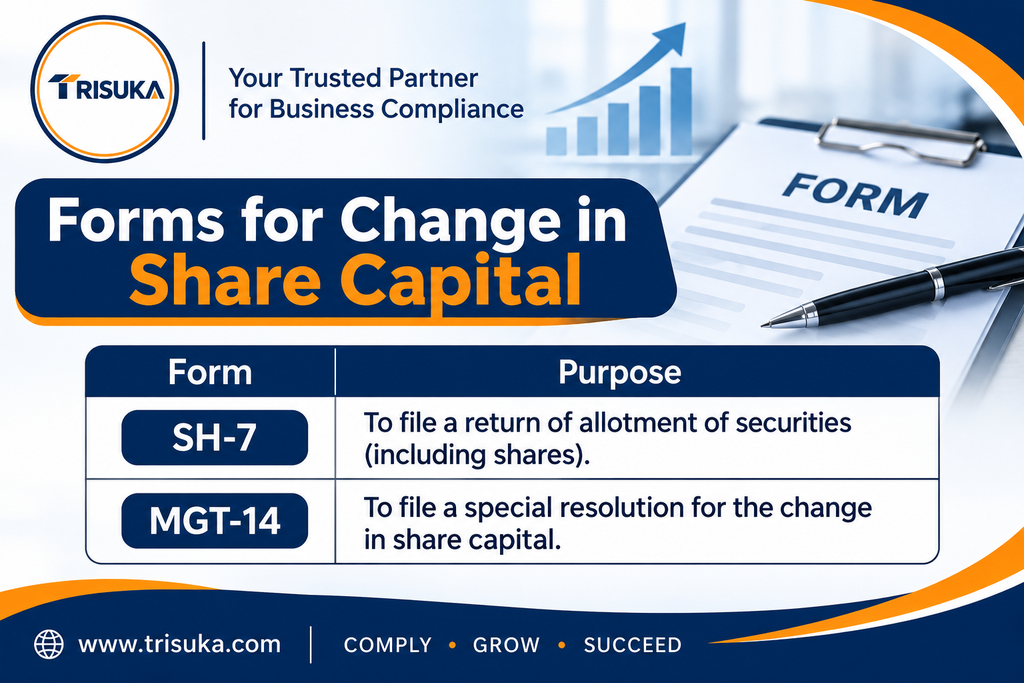
The SH-7 form is the notice sent to the ROC about an alteration of share capital under Section 64.
It is filed online on the MCA portal. It must carry the altered capital clause of the MoA and the AoA, where applicable.
When Is MGT-14 Needed?
MGT-14 is filed to report certain resolutions to the ROC.
For a share capital increase, MGT-14 is mainly needed when the AoA or MoA are changed through a special resolution. If the AoA already allow the increase, the SH-7 filing may be enough for your company.
Check the latest rules on the Ministry of Corporate Affairs website before filing.
SH-7 vs MGT-14 at a Glance
| Point | SH-7 | MGT-14 |
|---|---|---|
| Purpose | Notice of alteration of share capital | Filing of specified resolutions |
| Law | Section 64 | Section 117 |
| Time limit | 30 days | 30 days |
| Key attachments | Altered MoA and AoA, notice, resolution | Certified copy of resolution, explanatory statement |
| When needed | Every alteration of share capital | When a special resolution is passed |
How to File SH-7 Online on the MCA Portal
SH-7 is an e-form. The filing flow is simple.
- Log in to the MCA portal with the company’s or the professional’s user ID.
- Open the e-form section and select Form SH-7.
- Enter the CIN and fill in the existing and the altered authorised capital.
- Attach the altered MoA, the altered AoA, the notice, the explanatory statement and the resolution.
- Check the form for errors, and affix the Digital Signature Certificates (DSC) of a director and the certifying professional.
- Pay the ROC fee and note the Service Request Number (SRN).
- Track the status till the ROC approves the form.
Keep the SRN safe. You need it to track the form, or to resubmit it if the ROC raises an objection.
A change in share capital is complete only when the ROC has processed the form and the MCA master data shows the new authorised capital.
Tip: Use the same resolution date and capital figures in every document. A small mismatch is a common reason for rejection.
Keep these documents ready:
- Certified copy of the board resolution.
- Notice of the general meeting with the explanatory statement.
- Certified copy of the shareholders’ resolution.
- Altered Memorandum of Association (MoA).
- Altered Articles of Association (AoA), if changed.
- Digital Signature Certificate (DSC) of a director or authorised signatory.
- Certificate from a professional (CA, CS or CMA) for the filing.
Fees for a change in share capital have three parts:
- ROC filing fee: this depends on the amount of the increase. The MCA fee schedule lists the exact slab.
- Stamp duty: this is paid on the altered MoA and AoA. It differs from state to state.
- Professional fee: this depends on the expert you hire.
Rates change from time to time, so always confirm them on the MCA portal and with your state’s stamp office.
Stamp Duty on Change in Share Capital
Stamp duty is a state subject. The amount depends on the state of your registered office and on the size of the increase.
Some states charge a percentage of the increase with an upper cap. Others use fixed slabs.
Check your state’s stamp office or e-stamping portal before you print the altered MoA and AoA. Wrong stamping can lead to objections later.
Time Limit and Penalty for Delay
The notice in Form SH-7 must be filed within 30 days of the resolution.
A delay in reporting a change in share capital attracts additional filing fees. Penalties under Section 64 can also apply to the company and its officers in default.
So, plan the filing in advance and keep all documents ready.
Common Mistakes to Avoid
- Issuing shares before the authorised capital is increased.
- Forgetting to amend the AoA first when it is required.
- Missing the 30-day deadline for SH-7 or MGT-14.
- Paying the wrong stamp duty on the altered MoA and AoA.
- Using resolution wording that does not match the filed forms.
Getting SH-7 approved is not the end. Complete these follow-up steps:
- Check that the MCA master data shows the new authorised capital.
- Update the statutory registers, and keep certified copies of the altered MoA and AoA.
- Issue the shares as per Section 62, through a rights issue, private placement or preferential allotment, with the right resolutions.
- File Form PAS-3 (return of allotment) within 30 days of allotting the shares.
- Issue share certificates within two months of allotment, and update the register of members.
- Show the new capital in your financial statements and the next annual return.
Many companies miss PAS-3 after a successful change in share capital. Add it to your compliance calendar so that the deadline is not missed.
The rules differ a little by the type of entity.
- Private limited company: all the steps in this guide apply.
- One Person Company (OPC): Section 61 applies in the same way. The sole member records the decisions, so check which filings are still required.
- Public company: the same sections apply. A listed company must also follow SEBI and stock exchange rules, and often needs e-voting.
- LLP: an LLP has no share capital, only partners’ contributions. A change in contribution is made by amending the LLP agreement and filing Form 3 within 30 days.
If you are unsure which route fits your entity, take professional advice before you start.
FAQs
How do you increase the authorised capital of a company?
Hold a board meeting, call a general meeting, and pass the resolution. Then file Form SH-7 (and MGT-14, if required) with the ROC, and update the MoA and AoA.
Which form is filed for a change in share capital?
Form SH-7 is the main form. MGT-14 is also filed when a special resolution is passed, for example to alter the AoA.
Is MGT-14 compulsory for a share capital increase?
Not always. It is needed mainly when a special resolution is passed. Check the case of your company before filing.
Can a company make a change in share capital without altering the AoA?
Yes, if the AoA already allow the increase. In that case, only the capital clause of the MoA needs to change.
Can authorised share capital be reduced?
Yes, to an extent. A company can cancel shares that nobody has taken up, if the AoA allow it. This is different from a reduction of issued capital under Section 66, which needs NCLT approval.
Is stamp duty payable on a change in share capital?
Yes. Stamp duty is paid on the altered MoA and AoA as per the law of your state. The rates differ from state to state.
Conclusion
A change in share capital looks technical, but it becomes simple when you follow the steps in the right order.
Check the AoA, pass the right resolution, file SH-7 and MGT-14 on time, and keep your records updated. You can read the Act itself on India Code.
Need help? The Trisuka team can handle your change in share capital from board resolution to ROC filing. Explore our company registration and compliance services or read our guide on Form ADT-1 to stay compliant with the ROC.
Disclaimer: This article is for general information only. Rules, forms and fees can change, so verify them on the MCA portal or with a professional before filing.

Anjali is a Digital Marketing Expert at Quick Startup India who builds websites that rank and convert. She specializes in SEO-driven web development, helping people find the right legal help online.

